

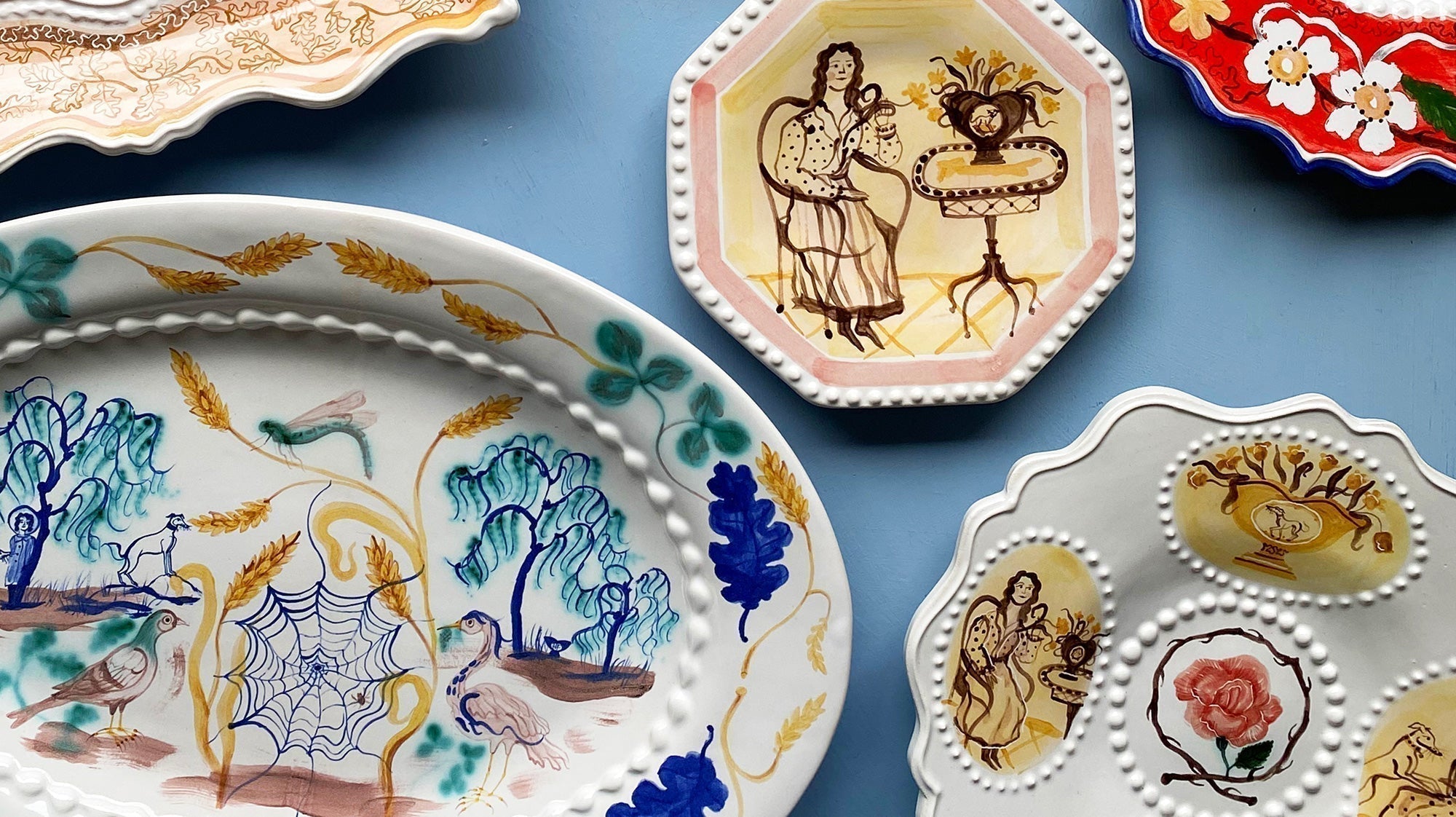
Following the launch of her first collection for Art Angels, we visited Polly Fern at her 17th-century Cork Brick Studio in Bungay, Suffolk, to learn more about her practice. A Norwich Art School graduate, she weaves storytelling into her work, drawing on history, architecture, and interiors.

You've been working from your Cork Brick Studio since 2024. Can you tell us a little bit about the building and how you came across it?
I live in the market town of Bungay here in Suffolk. I worked from a garden studio at home for many years with the dream of acquiring a historic building that I could turn into my studio. My friends ran a wonderful art gallery and antique business for nearly 35 years in town. One day, they told me that they were coming to retire, and it was such an unexpected lightbulb moment when I asked them if they would sell the building to me! It was very much meant to be.
It is a 17th-century building, which was one of the first properties to be rebuilt after the great fire of Bungay in 1688. The name Cork Bricks is the adjacent alleyway, said to be named after the then-owner of the building, whose wife fell ill. Her rest was disturbed by the clatter of horses and carts travelling across the cobbled stones in the alley beneath her bedroom window. So, Frederick paved the alleyway with cork bricks to muffle the noise.
You studied illustration at Norwich Art School - is this where you first started working with clay?
When I was a student at Norwich Art School, ceramics had become not such a popular medium to work in, resulting in the university getting rid of their kilns and ceramic department! I had a very strong urge to create with clay, so I searched for a ceramic studio. I lived in Norwich at the time and happened to come across one down a yard, which was a 5-minute walk from my house. I started with playing every Wednesday evening and built up a body of work for my illustration degree show, which was mainly ceramic! Working with clay was just a new form of storytelling for me.
The use of pattern seems to play an important role in the decoration of many of your ceramic pieces - might you be expanding your range of wallpapers in the future?
My wallpapers very much came from a place of searching for a particular print for my home and not being able to find the right one. This began with my Diamond Tulip wallpaper, followed by Pink Toile. I now have 4 designs, including my Bucolic print. I tend not to work to seasons but just creating designs when the time is right. I am very excited by interiors, which my work tends to span. My home and studio are very much an extension of my work and creative world.
When creating a new ceramic piece, does the shape and form determine the illustration, or the other way around?
I would say this can work both ways around. Sometimes ideas for shapes might come first and from various sources of inspiration, such as antique objects, architectural details, or furniture. Whereas sometimes I may have a story or illustration in mind where the ceramic form seems very clear.

Are there any recurring themes in the inspirations for your work?
I used to keep Canary birds and currently have two Whippets, Edgar and Cedric. They are ever-present motifs within my work. I always try to squeeze in a Whippet into my illustration commissions, sometimes they don't make the cut!
I collect antique pottery with a particular magpie eye for 19th-century Lustreware. My Canaryware pieces are some of my most treasured. The pieces I discover are always informing my collections, whether it be researching into the process behind the decoration, a particular detail on a handle, or the illustrative subject matter itself.
Was there a particular building that inspired your Festive Dutch Gable advent calendar?
The Shell Museum in Glandford, North Norfolk, was the inspiration behind the exterior of the advent calendar. Founded by Alfred Jodrell, it was purpose-built in 1915 to house his incredible shell collection. It also has some local archaeological finds and artworks, of which many are, of course, made of shells! A very inspiring place to visit.

What's the inspiration for your new series of Romantic Vases?
I've had the idea for some paper pop-up Romantic Vases in my head for many years. I've admired what Art Angels do since discovering them when studying at Norwich Art School, which happens to be situated opposite their office. When it came to creating the artwork for these vases, I looked back at some of my previous ceramic vases and the ones that I felt would translate well into paper.
I hand-build my Romantic Vases from slabs of clay. Before I create my vases, I always make a paper maquette to check that the structure and faces of the vessel will join together successfully. This was where the idea came from for the paper pop-up vases. I have a vast collection of Romantic Vase shapes. The heart-shaped vase was the very first shape I created in 2017, so I felt like this had to be included.
Can you tell us about what else you might have in mind for Art Angels in the future?
My brain is brimming full of potential 3D paper ideas. I've always worked with paper, creating 3D pieces of art. The illustrator in me loves working in a small and fiddly format. I am currently in the early stages of working on a collection of 3D follies, of which I plan to create in ceramic and card form...
Follow Polly's activities on Instagram or on her website.
Portrait photography by Jannine Newman.


