


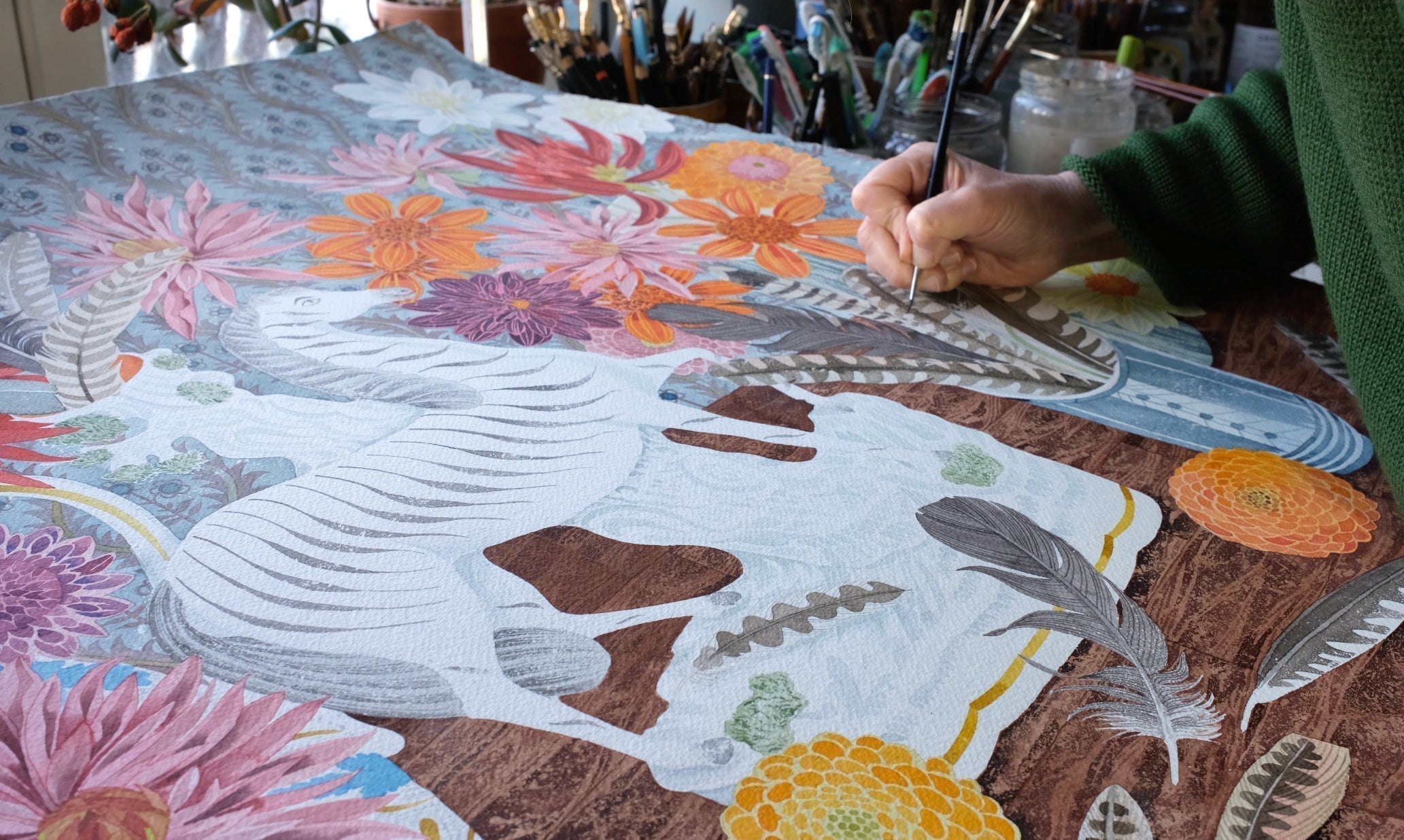
Artist Angie Lewin has worked with Art Angels for over twenty years, and this year marks the launch of our first 3D die-cut cards together. We spoke to Angie about the paintings behind the designs, her love of scale and process, and the flowers, ceramics and collected objects that shape her work.

We’ve been publishing your prints and watercolours as greeting cards for twenty years, but these are the first 3D die-cuts we’ve produced together. How did this project come about?
I’ve had Emily Sutton and Mark Hearld’s 3D Art Angels cards on my studio shelves for many years, as I’d long been hoping to find a way to create die-cuts from my own work. Chatting through ideas with Polly and Emily in the Art Angels studio last summer was really helpful, and we decided that my watercolours might be a good starting point.
When I’m working on a painting, it gradually evolves, with different elements being added, and a 3D die-cut card, with its layers, reflects the way I build up the still-life compositions I create in the studio. Dahlias and Dogs and Zebra, Dahlias and Feathers were chosen as they feature the vibrant dahlias I grow to include in my paintings and prints, and to decorate the house, throughout late summer here in north-east Scotland.
The original paintings for the two die-cut cards are among your largest works. Do you enjoy seeing your work used at a different scale?
Yes, very much so, perhaps because I’ve always enjoyed working at different scales. The contrast between creating fine detail in my small wood engravings and drawing or painting onto sheets of film to build up layers of transparent colour in a large screenprint or watercolour has always been a vital part of how I work. Different processes have their own qualities, which are further transformed when an image is enlarged or reduced in scale.
I’ve always enjoyed collaboration and seeing how a new process can transform an original image. When I first moved to London as a student, I particularly loved the murals on the platforms at Charing Cross Underground station. I was studying printmaking at the time and realised that the elements in David Gentleman’s design for London Underground were actually hugely enlarged wood engravings. The finely engraved lines, scaled up, had become broken, and areas of solid black had turned speckled and textured, more like a woodcut, and so entirely different from the original artwork.

More recently, in 2024, I was invited to work on a tapestry with Dovecot Studios in Edinburgh. The weavers, like me, were excited by the idea of creating a tapestry based on my small wood engraving Teabowl and Bracken, which measures just 5 × 7.5 cm. The finished piece would be 75 cm × 1.1 m. In this case, the change of scale was also accompanied by a transformation of medium, from ink printed onto fine Japanese paper to a tactile woven object. As a result, the image became something very different. The print quality was somehow emphasised when translated into weave: any slight misregistration was exaggerated, and the layered printed colours were reinterpreted through different yarns into a rich visual and physical texture.
We’ve previously published some of your fabric and wallpaper designs for St Jude’s as gift wrap. Is this the first time your watercolours have been used as the starting point for a repeating pattern?
That’s right. As with my previous designs, the new Spring Flowers wrapping paper is double-sided, with a different design on each side. This allowed us to use two of my watercolours, which depict tulips, fritillaries and auriculas — all spring flowers that I grow in my garden.
In my paintings and prints of garden and wild flowers, I’m drawn to the patterns made by twisting and intertwining stems, how every flower and leaf is subtly different, and how different species grow together, each finding its own place. Emily at Art Angels has created flowing repeats from the floral elements in the paintings, so that the character of each is retained while forming fresh designs, rather than simply reproducing the original watercolours.

Can you tell us about the ceramics and other objects that appear in the paintings? And do you grow the flowers used in the compositions yourself?
I have an eclectic range of ceramics in my studio, and in the house too, which I’ve collected over many years. My earliest piece is a tiny hand-painted coffee cup given to me by an elderly relative when I was a small child. Staffordshire figures, Sunderlandware, Georgian tea bowls, mochaware and delftware are displayed on shelves and in cabinets alongside Rye and Hornsea pottery, and tableware designed by Eric Ravilious for Wedgwood.

I also collect contemporary ceramics, including Terry Shone’s flatback greyhounds and mochaware, and work by Akiko Hirai, whose simple cups and vessels have cracked and pitted glazes that are fascinating to recreate in watercolour. Both of the new die-cut cards feature ceramics from my collection. In the studio, pots and cups are filled with feathers, dried seedheads and lichens, while others are used to display fresh flowers picked from the garden.
The Dahlias and Dogs card features a Terry Shone greyhound, some Staffordshire wally dogs (or wally dugs, as they’re known in Scotland), and a large tankard by Mark Hearld featuring a joyful depiction of his pet lurcher, Brio. In Zebra, Dahlias and Feathers, the zebra is one of a cherished pair that I coveted for many years before finally receiving them as a surprise birthday present. The stripes on the zebra reminded me of the bands and markings on the feathers I collect and store in pots and boxes in the studio, so these are scattered among the dahlias and placed throughout the composition.
In recent years, I’ve begun to grow the majority of the flowers that appear in my paintings and prints. I also sketch and paint wildflowers on walks and sketching trips, but I’m lucky to have a fairly large garden, much of which is left to grow wild. Here I can pick campion, devil’s-bit scabious, primroses and fritillaries for my still-life paintings. I live on the side of an exposed hill in north-east Scotland, so I grow cultivated plants in any sheltered spots I can find, and I also have a Polycrub — a Shetland-produced polytunnel — which can withstand the wild weather here. In it I grow dahlias, parrot tulips, anemones, ranunculus and other flowers. I love the contrast their saturated colours and exotic shapes make with the softer greens, purples and browns of the surrounding Speyside landscape.
Explore our range of paper goods by Angie Lewin for Art Angels
Angie Lewin is a British painter, printmaker and designer whose work is inspired by the landscapes of the North Norfolk coast and the Scottish Highlands. She is known for her distinctive depictions of flora, still life and the natural world, and is a member of the Royal Watercolour Society, the Royal Society of Printmakers and the Society of Wood Engravers. Angie has also collaborated with writer Christopher Stocks on a recent series of books published by Thames & Hudson — The Book of Pebbles, The Book of Wild Flowers and The Book of Garden Flowers.
Studio portrait by Esme Saville.
Dovecot Studio tapestry photographs by Peter Dibdin.


