

James Mayhew's illustrations have long been shaped by a belief that children should have as much access to the arts, to galleries, orchestras and old paintings, as any adult. Working from the Waveney Valley on the Suffolk and Norfolk border, he draws on medieval and Renaissance imagery, a lifelong love of music, and forty years of visiting schools and stages alike. We caught up with James to talk about his childhood influences, his illustrated concerts, and the ideas behind his Art Angels designs.
Are there any illustrated books you remember vividly from your own childhood – ones that first made you want to make pictures yourself?
We didn't have all that many illustrated picture books at home, so the ones we did have made a huge impression. I loved The Little Red Engine by Diana Ross with Lewitt-Him's illustrations. At the time I had no idea it was two people! Then there was The Story of Ferdinand by Munro Leaf, illustrated by Robert Lawson. I also loved John Burningham's illustrations for Ian Fleming's Chitty Chitty Bang Bang. I remember borrowing certain books from the school library, Maurice Sendak's Where the Wild Things Are, for example, and books illustrated by Brian Wildsmith. I was really interested in line work and how worlds could be created with ink line. So Ardizzone made a big impression – those wonderful trees he drew! And Tove Jansson, with her extraordinary seas, skies and foliage in her Moominvalley. I hold them all dearly in my illustrator's heart!

You trained at Lowestoft School of Art and then Maidstone College of Art. Looking back, what stayed with you from those years. Any teachers, disciplines or habits that still shape how you work now?
I especially loved my time at Lowestoft, for a Foundation Course. I really enjoyed trying all the disciplines, and the experimentation. Later, at Maidstone, where I did an illustration degree, it was in the print-making studios that I was really happy. I wasn't a very good print-maker but I learned a lot, enjoyed the process, and now, recently, I've started to allow all of that into my work. The tutors at Maidstone included Gerald Rose, whose books I admired greatly, especially his early work in the 1960s. But he was very shy about it all and never really spoke about his work. We had some visiting lecturers who made deeper impressions – Charles Shearer, who got me excited about typography and print, and Angela Barrett, who is one of our greatest living illustrators I think. I was in awe of her!
Your Katie books began with a summer spent as a pavement artist recreating famous paintings, whilst still a student. Do you remember the moment that turned into the idea of a child climbing inside a picture?
Yes, very clearly. I was 18, preparing to go to Lowestoft College of Art, and together with a friend, started recreating "old masters" on Station Square in Lowestoft in chalks and pastels – Monet's Poppyfield, Constable's Haywain, even the Mona Lisa.
Firstly, I discovered how much I loved, and how much I learned, recreating and studying these great paintings. But what really fascinated me was how many children, holidaymakers mostly, would stop, fascinated to see an artist at work. Some of them recognised the paintings, but it was clear that none of them had ever been to a gallery. Something about seeing an artist draw them, made the pictures almost alive for them – like a kind of animation.
I grew up in rural Suffolk, far from museums and galleries, but I'd been lucky – my grandmother had, on occasion, taken me and my sister Kate, to museums, which made a huge impression on me as a small child. So I realised there needed to be a book that would inspire other children to go and experience these magical places, and maybe, by making the painting really magical, that could be the way.
Nowadays there are many books about art for children, but this was about 45 years ago, in the early 1980s, and I don't think there was anything for children at that time. I think Katie's Picture Show was quite a pioneering book in its own small way.
Your illustrated concerts sound fascinating – can you tell us what's involved, and how they come about?
I've always been a storyteller, and I've always drawn illustrations whilst telling assorted tales. One of the tales I tell quite often is The Firebird. After speaking at a festival in St Albans I was invited to join a local orchestra, the de Havilland Philharmonic, for a family concert. So we did Peter and the Wolf and Stravinsky's Firebird, and I had to develop a whole new way of painting that was bold and fast, allowing me to keep up with the music, and which showed up well, when projected onto a screen. Filigree ink line didn't work at all! So I experimented with gouache on black paper, or bright inks on white. Somehow it all worked, and since then, more and more orchestras or ensembles have invited me to collaborate on a huge range of repertoire.
I think combining art and music makes the music really accessible. The paintings are choreographed to emphasise what the music is expressing, the climaxes, the different shifts in tempo or emotion… Too often people go to concerts and the music washes over them, or they lose concentration. The music is a "nice tune" but sometimes, that's not enough. Programmatic music can tell a story too, so providing that context really helps. I really believe that having a visual memory of the music makes it much more meaningful. It's a great first concert experience for the young and the old.

You've been visiting schools for over thirty years. Has the way children respond to stories and pictures changed in that time, or does the wonder stay much the same?
People talk about attention spans and concentration getting shorter, but I think if children are inspired enough, through demonstrations and exciting ideas, then they are as wonderful and brilliant and creative as ever. I do think that in classroom situations things can be challenging. I hear about children starting school who can "swipe" but not hold a pencil. But when I visit schools and run workshops you can quickly tell which schools have a creative culture, and those are the children who respond best. I think, also, in this digital age, there is sometimes even more wonder when seeing something real, like a piece of art created before their eyes.
You live on the border of Suffolk and Norfolk – does that landscape find its way into your work?
Yes, very much so. The Waveney Valley is a lovely, liquid landscape, not flat, as many imagine it, but a gentle embrace of a valley with rolling hills and water meadows. Skies are big here and the light is incredible. All of that seeps into my work, and these lovely landscapes are, I suppose, my default. But of course, my illustrative work is ultimately guided by text. If a story describes mountains then the illustrations must have them, and obviously I need to look beyond Suffolk!
You've worked across so many forms – picture books, opera and ballet-themed projects, concert presentations, collaborations with other authors. Is there a thread that ties it all together for you?
Yes – a passion for the arts, and a fundamental belief that children should have the opportunity to access them, is at the core of most of my work. It's been a battle – most publishers have been hard to convince, worrying that books about art, music etc will be uncommercial, which is one reason why I do so many things beyond the world of publishing – like the illustrated concerts. But the fact that my first book, about Katie in the art gallery (Katie's Picture Show), has now been in print for forty years, says something, I think.
Is there a museum, gallery or particular painting you keep returning to – one that still has more to give you?
After graduating from Maidstone I lived in Great Chesterford with my parents for a while – my father worked in Saffron Walden at that time. So I'd visit the Fry Gallery very often, and what an inspiration it is – with such a range of practices, from Ravilious ceramics and Sheila Robinson's illustrations to assorted theatrical designs, Bawden's prints etc, all housed in a doll's house sized gallery. Completely magical and always inspirational.
Can you share some of the inspiration behind your Fairy Tale Castle 3D die-cut card for Art Angels? Is this the first time you've worked in three dimensions?
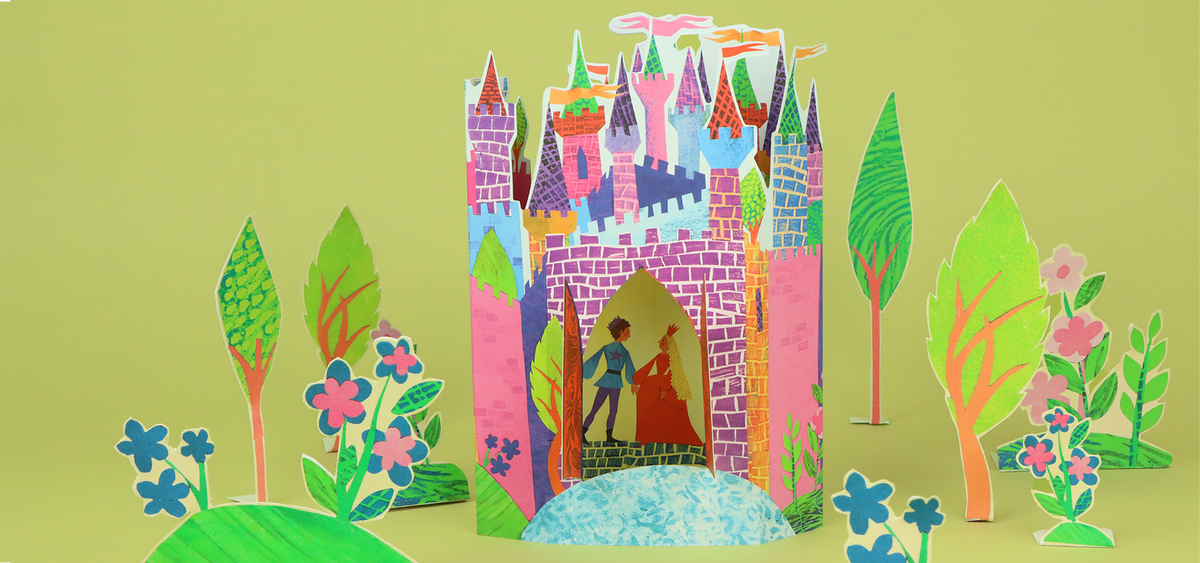
Polly Fern saw an illustration of a city with many towers in one of my books, created with collaged linocuts. She asked if I could do something similar for Art Angels on the theme of a fairy tale castle. Immediately I thought of The Sleeping Beauty, in particular Tchaikovsky's ballet, which I love. So originally I imagined a distant castle viewed through a forest of roses, but gradually it evolved so the castle is the main part of the design. I love fairy tales so I was in my element!
Can you tell us about the inspiration behind your Art Angels designs more broadly?
I looked at medieval and Renaissance images of castles and cities, Giotto, Lorenzetti etc, with the slightly skewed perspective. I adore Italian frescoes. I also love mid-century illustrators whose work was clearly also inspired by medieval art – Alice and Martin Provensen, for example, and Art Seiden. In the end, with the linocuts and the collage process, whatever my vision, it takes on a life of its own, and I just play until it looks "right".

What are you working on at the moment, or looking forward to next?
My new book this year is a retelling of Prokofiev's Peter and the Wolf so I'm preparing to promote that with a series of concerts with orchestras. I'm also working on my next book, which is a bit of a departure. It's a non-fiction title about dinosaurs, and I'm illustrating it all in collage, with all sorts of exciting textures for dinosaur skin and prehistoric plants and landscapes. It's very exciting, and I have paper and glue everywhere, which makes me very happy. I work best when surrounded by a creative mess!
Explore our James Mayhew collection and visit James's website.


